
What is Jugendstil?
Jugendstil, meaning "Young Style," was the German version of the broader Art Nouveau movement that swept across Europe at the turn of the 20th century. Named after the magazine Die Jugend, it revolutionized modern design by emphasizing floral motifs, arabesques, and organically inspired lines.
Jugendstil furniture, architecture, and illustrations were characterized by organic shapes and lines that were both simple and dynamic. While sharing naturalistic floral motifs with the broader Art Nouveau movement, Jugendstil evolved to contrast these organic forms with abstract and geometric elements, creating a more intricate sense of movement.
Many Jugendstil artists were skilled in multiple disciplines and aspired to create a Gesamtkunstwerk- a total work of art. Rooted in 19th-century ideas, this concept sought to unify all art forms into cohesive, harmonious environments designed for human use.
Although Jugendstil celebrated individual creativity, it also aimed to make art accessible to a broader audience. By establishing workshops across Germany, its artists collaborated with industrial designers to produce objects that could be efficiently mass-produced, blending artistry with functionality.

Organic Shapes

Geomentric Shapes

Whiplash Curve Motif

Flowers and Vines

Influence of English Arts & Crafts Movement
1860

The Arts & Crafts Movement began in the UK around 1860 as a reaction against industrialization, valuing craftsmanship, natural materials, and simple, functional design. Its ideas spread to the U.S. in the 1890s and inspired related movements, including Art Nouveau, or Jugendstil, which emerged in Europe in the late 1880s. While both styles emphasized nature and drew from the Gothic, Art Nouveau embraced modern technology and ornate designs, blending influences like the Baroque and East Asian art.

Art Nouveau, known as Jugendstil in Germany, flourished during this period with its flowing, organic lines inspired by nature. Influenced by Japanese prints and artists like Aubrey Beardsley and Paul Gauguin, it sought to break from 19th-century historicism, blending ornament and structure in architecture, design, and applied arts. This innovative style used materials like glass, iron, and ceramics to create unified, nature-inspired forms. The movement gained prominence through galleries like Siegfried Bing’s L’Art Nouveau in Paris and shaped design across Europe and beyond.
Art Nouveau Begins
1890
Art Forms in Nature, by Ernst Heinrich Haeckel (1834-1919), a German physician, biologist and nature philosopher.
1890
.png)
mucha
Alphonse Mucha, born in Moravia (now the Czech Republic), was a leading Art Nouveau illustrator known for his iconic posters of idealized women. After studying art in Prague, Munich, and Paris, he rose to fame in the 1890s through his work with actress Sarah Bernhardt, creating theatrical posters like Gismonda (1894) as well as sets and costumes. His posters, marked by flowing lines, ornate detail, and sensuous depictions of women, reflected the influence of the Pre-Raphaelite aesthetic, particularly Dante Gabriel Rossetti. Mucha’s work, celebrated for its elegance and refinement, became a hallmark of the Art Nouveau style, blending beauty and ornamentation in a uniquely captivating way.
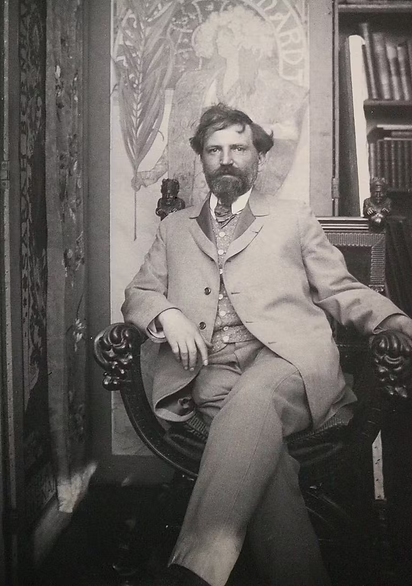

1892
Munich Secession
The Munich Secession, founded in 1892 by artists breaking from the conservative Academy of Fine Arts, became a key driver of modern art in Germany and Austria. Rejecting rigid academic methods and censorship, the group sought to foster creativity and unique artistic expression. Their first exhibition in May 1892, featuring artists like Max Klinger and Auguste Rodin, attracted over 42,000 visitors and established their prominence. Influential figures such as Wassily Kandinsky, Franz Marc, and Paul Klee were associated with the movement, which significantly influenced expressionism and avant-garde art. Though dissolved in 1913, its impact on modern art endures.

1895
Hermann Obrist’s Whiplash Motif

Obrist's famous whiplash curve design was first presented, becoming a hallmark of Jugendstil's organic and flowing forms

Magazine "Jugend" is Founded
Founded in Munich in 1896 by Georg Hirth, Jugend ('Youth') was a groundbreaking German art magazine that inspired the Jugendstil (Art Nouveau) movement. Published weekly until 1940, it championed modernist aesthetics, blending vibrant art, literary styles, and bold social commentary. Renowned artists like Otto Eckmann and Hans Christiansen contributed to its pages, emphasizing creativity and rejecting outdated conventions. With innovative marketing and a liberal, anticlerical spirit, Jugend became a cultural phenomenon, shaping modern art across Europe.
_pn.png)
1896

Cover by Otto Eckman
_edited_edited_edited.png)

Henry van de Velde
1896
Henry van de Velde, a Belgian architect and designer, was a pioneer of Art Nouveau, known for his sinuous, nature-inspired lines. In 1896, he introduced the style to Paris by designing interiors for Samuel Bing’s galleries. Van de Velde made significant contributions as a teacher in Germany, particularly in Weimar, where he reformed art education, laying the groundwork for the Bauhaus under Walter Gropius in 1919. His association with the Deutscher Werkbund further shaped modern design, including his theater design for the 1914 Werkbund Exposition in Cologne. His legacy endures as a bridge between Art Nouveau and modernism.


Otto Eckmann

1897

Otto Eckmann, a German painter and graphic artist, became a key figure in floral Jugendstil after moving away from academic painting in the mid-1890s. Educated in Hamburg, Nuremberg, and Munich, he contributed to influential magazines like Jugend and Pan and maintained ties with Hamburg’s arts and crafts community. In 1897, he moved to Berlin, where he taught ornamental graphics at the arts and crafts museum. Eckmann was also a co-founder of the Munich Secession in 1898, solidifying his influence on the Art Nouveau movement with his nature-inspired designs.
The Darmstadt Artists' Colony
The Darmstadt Artists’ Colony, founded in 1897 by Grand Duke Ernst Ludwig of Hesse, became a hub for architectural and artistic reform on Mathildenhöhe in Darmstadt, Germany. The colony featured experimental buildings and landscapes blending Art Nouveau, Arts and Crafts, and Vienna Secession influences, culminating in modernist designs. Expanded through four international exhibitions (1901, 1904, 1908, 1914), the colony exemplified the "Gesamtkunstwerk" ideal, merging architecture, design, and art into a unified whole. Its legacy shaped modernist movements like the Deutsche Werkbund and the Bauhaus.

1897


Famous Jugendstil Building: Elvira Studio
1897

August Endell’s Atelier Elvira in Munich was a striking example of Jugendstil, known for its exaggerated dragon-themed plaster facade painted in vibrant colors that changed yearly. Despite its bold artistic significance, the building faced disdain from Nazi authorities, who removed the facade in 1937, and was later destroyed by Allied bombing, leaving only photographs to remember this place.


Role of the Vienna Secession
1897
The Vienna Secession an art movement, founded in 1897 by artists like Gustav Klimt, shared Jugendstil’s desire to break from the past. Although based in Austria, it influenced Jugendstil through its emphasis on freedom in form and decorative experimentation


1900
Peter Behrens
Peter Behrens, a key figure in modern architecture and design, played a role in the transition from Jugendstil to modern industrial design. Initially associated with the Darmstadt Artists’ Colony in 1900, where he designed his own house in the Art Nouveau tradition, Behrens later redefined his approach through functional aesthetics. As artistic adviser for AEG in 1907, he brought Jugendstil’s focus on unity and craftsmanship into the industrial sphere, designing iconic products, logos, and factories.
Ernst Ludwig House
Designed by Joseph Maria Olbrich in 1901, the Ernst Ludwig House in Darmstadt became a hallmark of Jugendstil architecture. Its innovative and artistic design reflected the ideals of the colony and was a model of Jugendstil’s holistic approach

1901
_pn.png)
Jugendstil in Graphic Design
Graphic design flourished in Germany with Jugendstil posters, typography, and book illustrations emphasizing organic lines and floral motifs.
1890s-1910s

1902
Exhibition of Decorative Arts in Turin
Jugendstil artists participated in the International Exhibition of Modern Decorative Art in Turin, alongside other Art Nouveau designers.


_edited.png)
1868–1957
Richard Riemerschmid
Richard Riemerschmid, a prominent figure in the Jugendstil movement, blended handcrafted elegance with early modernist ideas in his furniture, architecture, and city planning for Hellerau, Germany. His innovative designs, including luxury interiors for the SS Kronprinzessin Cecilie, continue to influence decorative arts and modern design.

1914
The Glass Pavilion
Bruno Taut’s 1914 Glass Pavilion at the Cologne Deutscher Werkbund Exhibition embodied Jugendstil’s integration of art and architecture with its "prismatic" glass design and poetic details by Paul Scheerbart. Merging beauty and innovation, it bridged Jugendstil’s ornamental elegance with the emerging modernist aesthetic.
1910's
Jugendstil in Objects
Jugendstil was wide spread in applied arts, including ceramics, jewelry, and furniture, characterized by flowing, nature-inspired motifs.


1914-1920
End of Jugendstil

Jugendstil declined after World War I as new modernist movements like Bauhaus and functionalism took over.

